Les Mandarin Jakarta Tangerang dan Online.

Jago Mandarin Group

  • Home
  • Guru
  • Program
    • Biaya
    • Mandarin Bisnis
    • Ujian HSK
    • Korporat
  • Online
    • Surabaya
    • Medan
    • Bandung
    • Makassar
  • Lainnya
    • Jasa Penerjemah
    • Loker Tangerang
    • Buat Nama Mandarin
  • Gratis
    • Tes Kemampuan
    • Artikel

Asia first bilingual food education book: educating kids to think. cook. save. our food release today

June 04, 2015 by Baldwin Husin

(Hong Kong, 9th June, 2014) Think. Cook. Save., a Health and Food Education program organized by Go.Asia (www.go.asia), partnered with Alvina Cookery and Towngas Cooking Centre announce to release a new book, “Educating Kids to Think. Cook. Save. Our Food” today.

The book is to further promote the concept of Think. Cook. Save. Not only is the book a healthy diet guide, the book also provides a systematic structure to educate children on balanced diets. The guide will target parents, teachers and those who are interested in learning more about food and healthy diet. The book will be sold at Towngas Cooking Centre and all major bookstores. The authors will be donating the royalty fee to support the food education program.

Content Summary

“We need every child to understand where food comes from, how to cook it, and how it affects their body. This is about setting kids up with the knowledge they need to make better food choices for life.” Jamie Oliver

This book is a complete guide to teach children how to develop a healthy diet!

Baca Juga: Tempat Kursus Bahasa Inggris di Pare yang Harus Diketahui

Introducing the concept “Think, Cook and Save,” we aim to help children to get rid of bad eating habits, including junk food addiction and wasting food.

Think: To know where your food come from and learn more living skill.
Cook: To cook together and learn some simple, fun and healthy recipes
Save: To cherish our food resources

Highlight

The concept of Think.Cook.Save. comes from Jamie Oliver’s Food Revolution Hong Kong division
Hong Kong First Food Education book. Food Education is popular in Switzerland, Belgium, Italy and other European countries, it has been the talking point in Japan and Taiwan recently and it’s now landed in Hong Kong!
Advisory Team: Professor Joseph J.Y. Sung, President, The Chinese University of Hong Kong, Mr. William, Mark Yiu Tong, Renowned Food Critic, Mr. Perry Mak, Publisher, Hong Kong Economic Times and Towngas Cooking Centre
Recipes designed by Celebrity Chef Alvina Chan, Food Revolution Ambassador Beatrice Chan and the tutors from Towngas Cooking Centre
Bilingual Content. Good for education.
Massive use of color photos and cartoons. Children will love reading the book.
About the Authors

Alvina Chan
After graduating from Columbia University and Georgetown University, Alvina spent 7 years on Wall Street in New York & Hong Kong. Passionate about her culinary dreams, she attended Le Cordon Bleu Paris and achieved remarkable results, obtaining 1st in French Cuisine with “Mention Bien” (Distinction).  Given her positive influence in food culture promoting Healthy Cooking & Respect for Food, she is now the first disciple of Willie Mark, an internationally recognized food critic. Author of two books: “Banquets for the Soul,” & “Alone in Paris – Transforming Perspectives in the World’s Most Famous Cooking School,” She is now also a TV culinary show host for TVB and Creation TV.

Beatrice Chan

Chief, Go.Asia | Founder, Think.Cook.Save. Health and Food Education | Ambassador, Jamie Oliver’s Food Revolution | Columnist

Books available in :
Towngas Cooking Center (9A, Lee Theatre, Causewaybay)
and Major Book Store
Joint Publishing HK, The Commercial Press, Chung Hwa Book, Page One, Popular Book, Hon Wing Book Company, Eslite HK, Lagardere (Relay@HK Airport)


June 04, 2015 /Baldwin Husin

Southeast Asian parents want kids to use devices for learning – study

June 04, 2015 by Baldwin Husin

A recent study by TheAsianParent.com points to an overwhelming majority of Southeast Asian families with tablets and other mobile devices allowing their kids to use those devices.

Commissioned by Samsung Kidstime in partnership with TheAsianParent.com, "Mobile Device Usage Among Young Kids: A Southeast Asia Study” surveyed a representative sample of 2,714 parents from Indonesia, Malaysia, the Philippines, Singapore and Thailand with at least 3,917 children aged between 3 and 8 years. 

According to their findings, 98% of Southeast Asian parents allow their kids to use tablets and other mobile devices. From this, 80% primarily allow this to supplement their education.

Baca Juga: Bahasa Mandarin Jadi Mapel Baru di Afrika Selatan

Aside from education, however, some are primarily motivated by giving their kids early exposure to technology (68%), providing their kids with entertainment (57%), and keeping their kids preoccupied (55%).

Parents are also concerned with the negative effects of device use among their kids, with most being afraid of a risk to their children’s health (92%), followed by the risk of children becoming addicted to their devices (90%) or being exposed to inappropriate content (88%).

Parents are also concerned about high billing charges from in-app purchases made by their kids (67%), as well as damage to the devices themselves (60%).

The study also notes that 41% of the children are likely to use a device for longer than an hour, though for different uses depending on the age. 

The study says, "While children aged 3 to 5 years mostly consume educational apps, videos and games, children aged 6 to 8 years start playing more games in relation to using educational apps and watching videos.” This increase in playing games goes against what parents want their kids to use such devices for – education. 

This leads to most parents (94%) wanting parental control mechanisms. The most requested parental control features including the ability to set usage time limits on devices (72%), in-app purchase blocking and controls (67%), and the ability to monitor of children's usage or progress (66%).

June 04, 2015 /Baldwin Husin

Asia's wealthy want their kids to study abroad

June 04, 2015 by Baldwin Husin

Wealthy people in Asia are investing more in their children's education, with those in China favoring having their children study overseas with other students of the same social status, according to Shanghai's China Business News.

Lee Woon Shiu, managing director and head of Wealth Planning, Trusts & Insurance at the Bank of Singapore, said high net-worth individuals often hope their children can have a more international outlook and the first step is to send them to an international school.

To educate a child for 13 years at an international school that covers both primary and high-school education in Hong Kong, parents need to pay over HK$2 million (US$260,000) in tuition, the paper said.

There are also other fees, such as a capital levy and the cost of other activities, the newspaper added.

Lee added that many parents also emphasize education in areas outside basic school subjects, such as music, theater and dance, and private banks usually arrange events for their customers and their children to interact with artists.

A more recent trend taking place among the rich in Asia, the newspaper said, is making big donation to schools. Chinese property developers Pan Shiyi and his wife Zhang Xin donated US$100 million to Yale University, while Chinese-Australian Kingold Group chair Zhou Zerong gave AU$25 million (US$19.6 million) to the University of Technology Sydney.

Baca Juga: Tarif Penerjemahan Bahasa Mandarin

Lee said the donations may not have been made specifically to pave the way for the donors' children to be accepted by the schools, but it will certainly help with future applications.

Asian parents are also eager to see the school for themselves. In a 2014 survey on why wealthy individuals travel abroad, the fourth most commonly cited purpose, at 12%, was to check schools for their children, ahead of going abroad to check on investments or immigration opportunities.

As a result, private banks also arrange such trips for their clients, summer camps for their children, or meetings with heads of recruitment at prominent schools, the newspaper said.

High net-worth people in Asia, Lee said, also pay great attention to whom their children study with, preferring that their classmates come from the same social circles.

Parents often choose a school for their children based on such factors as the percentage of graduates accepted by Ivy League schools and the backgrounds of the students' parents, Lee added.

The education survey of the wealthy conducted by the Hurun Report also found that 80% of respondents in China planned to send their children to study abroad, the highest percentage in the world.

Some 19.4% of respondents said they would invest in a foreign country for their children's education, the second most popular reason for investing abroad, according to the Hurun Report survey.

June 04, 2015 /Baldwin Husin

Expat Kids Education – Go Local or International?

June 04, 2015 by Baldwin Husin

The question of what school your child will attend in a new country is one that many expats have to face. One of the principle concerns many expats face is ensuring that their children receive the best possible education while living abroad. However, this is a feat that can be fraught with complications.

While every country’s education system is different, and while one must be wary of making sweeping country-wide generalizations about education, there are some universal conclusions that one can draw about certain types of schools.

While not every expat will have the option of sending their child to either a local school or an international one, those that do will need to realize that it’s important to understand the benefits and disadvantages of these two different types of schools.

Baca Juga: Mandarin Chinese Private Tutor Jakarta

Quality and Cost

In some countries, the state education system is of a high standard and local schools will often offer an education system that is as good as or even better than the curricula adhered to at various international schools, and most importantly, it won’t cost you a penny.

This is not necessarily always the case though, so first and foremost, expats should research the local public system, and evaluate whether or not it would be a plausible option. This process includes consulting with individual schools, with networks of expats who’ve had similar experiences and with families who have students currently enrolled in the schools.

Also for consideration is the fact that international schools around the world almost always have higher fees than public schools, yet they may not necessarily offer anything close to the quality of education or facilities that certain public or state schools can offer.

Cultural pros and cons

Furthermore, aside from offering the same level of quality, local schools also have the potential to provide a platform on which children can quickly become fluent in the local language. Chances are that children who attend local schools will also learn and understand the customs and culture of the local country much quicker; something which is important, especially if you intend to stay in a country long-term.

Being part of a local school community will also help you, as a parent, to become more involved in local events and issues, thereby giving you greater insight and appreciation for the country you’re in.

On the other hand, children who go to international schools often find themselves neither part of the culture of the country they are in, nor the country they are from, merely an approximation of it.

Thus, when they go to university they may find that many of their peers have completely different cultural touchstones, despite the fact that they went through the same education system.

If your child is attending an international school, it may be worth getting them involved in extramural activities, such as sports or social clubs, outside of their school. This may help them to meet and make friends with children from the local community, and it may encourage them to become better acquainted with the local language and culture.

University and college admission

The opportunities for further studies abroad or in a child’s home country may be more limited with a local school. Sending your child to an international school helps to broaden these prospects, and provides the opportunity to choose between a local university or one in your home country (depending on the teaching of your child’s first language).  At a time when university slots are scarce and fees are high, increasing the number of institutions your child can apply to may be worthwhile.

A compromise

Making a decision between local and international schools is often very difficult, and there are a lot of competing interests that must be balanced.  However, a good compromise is to send your children to a local school when they are young so that they get the benefit of becoming bi-lingual, then sending them to an international school for the last portion of their education.

This ensures that they get the best of both worlds; a second language, an experience of the local culture, local and international friends and a leg-up on furthering their education either in their adopted country or abroad.

June 04, 2015 /Baldwin Husin

Tutors tackling kids' homework for $250 an hour

June 04, 2015 by Baldwin Husin

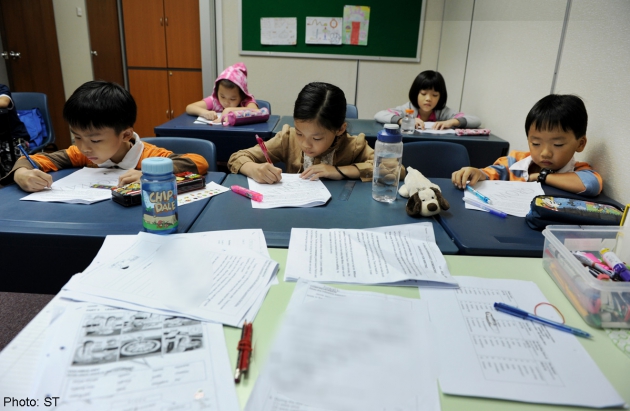
Some parents are paying up to $250 an hour for a tutor to come to their homes.
It is not for tuition lessons.

Instead, it is for the tutors to do their children's homework.
For these parents, it is something that cannot be helped, they say.
Their children are inundated with so much tuition, co-curricular activities and school assignments that they are struggling to cope.
Some tutors are even hired to complete primary school-level homework set by elite tuition centres.
Think of these tutors as homework elves. While the children sleep, these teachers do the assignments that need to be handed up the next day.

The rates are usually $200 an hour if the tutor travels to the child's home before midnight, and $250 if it is later.
A mother of a Secondary 3 student, who wants to be known only as Lilly, says she gets the tutors to come over whenever she realises her son is struggling with homework.
"Most of the time, the tutor will come by and my son will briefly tell him what is required," says the mother of two.
"While the tutor finishes the work, my son will do his other homework, or go to sleep if he is too tired."

Baca Juga: 4 Tips Belajar Bahasa Inggris 100% Work

Apart from just a problem of time, some parents feel that some of the assignments are superfluous.
They want to free up their children's schedule to focus on more important areas, rather than have them bogged down by unnecessary projects and homework.
Housewife Wendy Zeng, 40, feels that her 15-year-old daughter's assignments "serve no purpose".
When quizzed, she names project-based work that has no direct relevance to the subjects her daughter is studying, for instance a project on volunteerism, where the students had to dissect the pros and cons of being a volunteer.
"But they still have to hand in their homework. I prefer to get her to focus on what is more important. It is not like her grades have dropped or anything."
Madam Zeng spends about $800 a month on such services by tutors.
It is a lot to fork out, but it seems the high fees do not deter parents.
In 2012, The New Paper on Sunday polled 80 parents outside elite tuition centres in Singapore, and found that close to half had hired or would hire tutors to complete their children's homework.
Their job is to finish assignments handed out by the tuition centres which their children attend.
Pauline Soh, 43, hired a tutor to do the assignments given by the elite tuition centres that her 14-year-old daughter goes to.
The civil servant sets aside $500 to $700 a month for this tutor.
It had taken close to a year for her daughter to get a place at the tuition centre, and she wanted to ensure that her daughter kept her place there.

These elite centres have long waiting lists and entrance exams. They also require that a kid scores well to continue at the centre.
She reasons: "After all that effort, it would be such a terrible waste if she had to give up her spot for others on the waiting list just because she cannot finish the work."

June 04, 2015 /Baldwin Husin
  • Newer
  • Older

Guru
Biaya
HSK
Mandarin Bisnis
Korporat

Tangerang
Surabaya
Medan
Bandung
Makassar

Tes Kemampuan
Instagram
Artikel
Jasa Penerjemah
Lowongan
Jago Mandarin Online